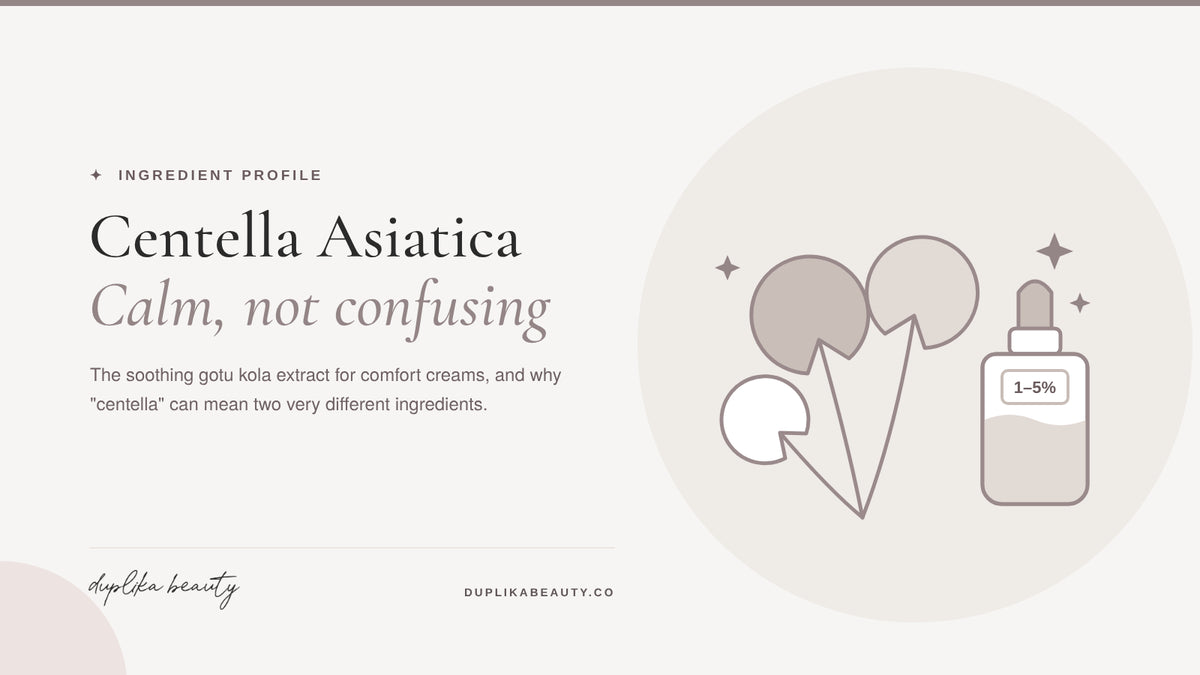
The calming botanical behind so many comfort creams, and why the word "centella" on a label can mean two very different ingredients with very different percentages.
Centella asiatica is a small, low-growing plant with round, scalloped leaves, also known as gotu kola. It has a long history in traditional use across Asia, and in modern skincare it is valued as a skin-conditioning botanical that helps skin feel calm, soft and comfortable. Its best-known constituents are a group of triterpenoids: asiaticoside, madecassoside, asiatic acid and madecassic acid.
For a home formulator, the most practical form is a liquid extract: the plant's water-soluble parts carried in glycerin and water. It is pale brown, it pours easily, and it stirs into a cream, gel or toner at cool down without any fuss. The one thing to understand before you use it is what is actually in the bottle.
At a glance
| INCI | Centella Asiatica Extract; a typical liquid grade lists Glycerin (and) Water (and) Centella Asiatica Extract. Some grades use Centella Asiatica Leaf Extract |
|---|---|
| What it is | Botanical skin-conditioning extract |
| Forms | Liquid glycerin-and-water extract (pale brown) · standardized powders sold under their own names |
| Solubility | Liquid extract is water soluble. Not oil soluble |
| Where it goes | Water phase, added at cool down below 40 °C |
| pH | No narrow window on most sheets; finish water-based products at 5.0 – 5.5 |
| Typical usage rate | 1 – 5% of the liquid extract |
| Carrier | Mostly glycerin and water, with the supplier's preservative |
What it does in a formulation
An expert panel review of centella-derived ingredients describes them as functioning primarily as skin-conditioning agents. In practice that means a cream or gel that feels soothing and comfortable, the kind of product people reach for when their skin feels tight, dry or easily bothered. Keep the label language there. Centella is not a wound treatment and does not need to be sold as one.
It plays well with other gentle water-phase ingredients: panthenol, allantoin, aloe vera juice and cucumber extract. Together they make a soothing gel or a light comfort cream that does not depend on any single star ingredient.
How much
For a liquid glycerin-and-water extract, the typical range on supplier sheets is 1 – 5%.
- 1 – 2% — a toner, mist or light gel
- 3% — the everyday rate for a serum or a comfort cream
- 5% — richer creams, keeping an eye on the extra glycerin it brings
- Above 5% — more color, more scent and more stickiness, with no reason to go there in a home batch
Extract strengths differ between suppliers, so always follow your supplier's sheet for the grade you bought.
The catch: centella is not one ingredient
This is the mistake. "Centella" on a product or a supplier listing can mean a liquid extract, which is mostly glycerin and water with a modest amount of the plant in it, or a standardized powder of one or more of its triterpenoids, sold under names like Madecassoside or Asiaticoside. They are not interchangeable. The powders are concentrated, used at far lower percentages, and harder to work with; one source puts a centella powder's solubility in water at no more than about 1%. If you swap a powder in at a liquid extract's rate, you are not making the same product.
The liquid extract has a hidden effect of its own: it adds glycerin. At 5% of an extract that is largely glycerin, you may be adding several percent of glycerin to the formula without noticing. If the base already has glycerin at its usual rate, the finished product can turn tacky. Check the INCI order on your extract, count its glycerin in your totals, and reduce the glycerin in the base if the feel comes out sticky. The formula still has to add up to 100, so record the grade in your batch notes every time.
Working with it at the bench
- Weigh it, always. Tare a small beaker on a 0.01 g scale and pour or pipette it in directly.
- Add it at cool down. Keep botanical extracts out of the 20-minute hold at 70 – 75 °C and stir it in once the batch is below 40 °C. In a cold-process gel, it can go straight into the water phase.
- Expect a little color. A pale brown extract can tint a white cream slightly beige and bring a faint herbal scent. That is normal, so note it on the label rather than masking it.
- Close the bottle. Light, warmth and humidity shorten its life. Put the cap back on as soon as you have weighed what you need.
Storage and shelf life
One supplier gives an 18-month shelf life when the extract is stored sealed, protected from direct light and humidity, at about 10 – 25 °C. Write the date you opened it on the bottle. If it darkens sharply, clouds, or smells sour or fermented, replace it.
Like most liquid botanicals, it arrives with its own preservative, often potassium sorbate and sodium benzoate, to protect the raw material in the bottle. That preservative is not enough for your finished product.
Keep reading
- Allantoin: Why Your Smooth Cream Turned Gritty
- Aloe Vera Juice
- How to Test Homemade Skincare for Bacteria and Mold
Every formulation in the guides gives you percentages, gram weights for a real batch, the method, the pH target and where to buy each ingredient.
See the guidesDuplika Beauty · duplikabeauty.co · This is formulation information, not medical advice. Patch test anything new.
Leave a comment.