

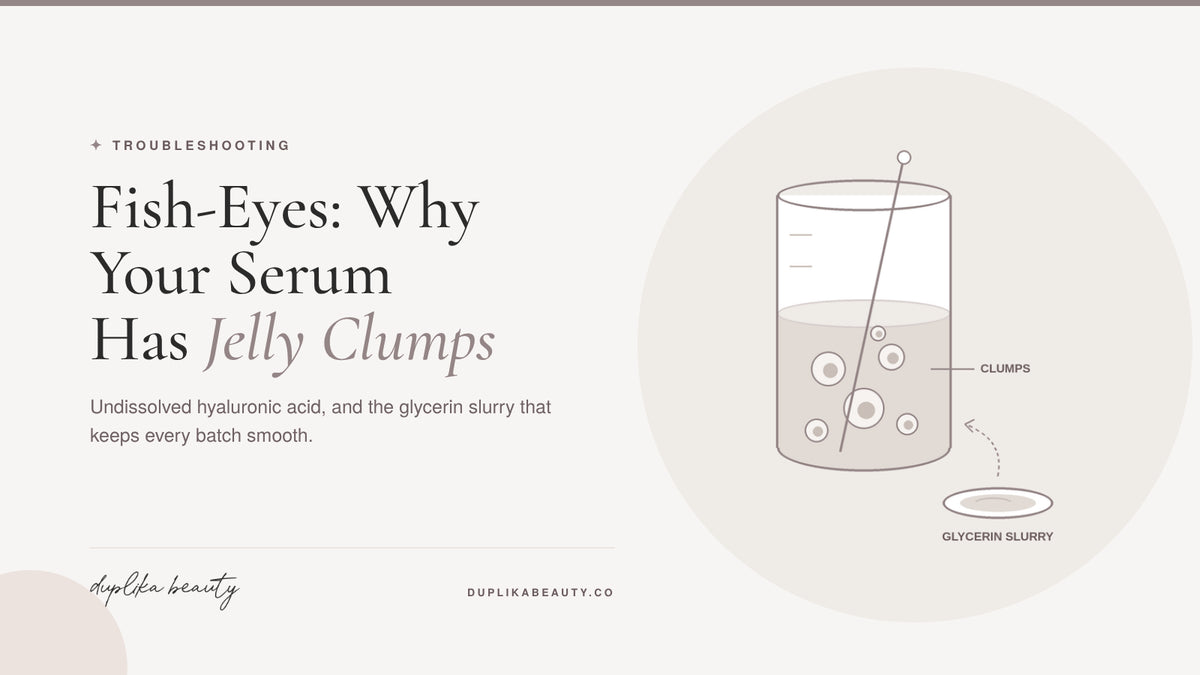
That small clear bead with a white speck in the middle is not mold and not a bad batch of powder. It is dry powder sealed inside its own gel, and it is the most common way a first serum goes wrong.
Formulators call them fish-eyes. They turn up whenever a water-loving powder meets water too fast: hyaluronic acid most often, with gums such as xanthan close behind. The serum looks smooth from across the room, then you tilt the beaker and see a scatter of jelly beads that will not dissolve however long you stir.
The good news is that fish-eyes are entirely a technique problem. Once you see why they form, they stop happening.
What a fish-eye actually is
Hyaluronic acid and the gums are hydrocolloids: long molecules that pull in water and swell into a gel. That is exactly the job you bought them for. The trouble is that they start doing it instantly, at whatever surface the water touches first.
Drop a pinch of powder onto water and the outside of the clump hydrates in seconds. That outer layer becomes a swollen, sticky skin, and the skin now stands between the water and the dry powder inside it. Water can only creep through slowly. The result is a gel shell around a dry core, and the white center is the giveaway.
It is the same reason flour lumps in gravy. The ingredient is fine. It simply met the liquid all at once.
High molecular weight hyaluronic acid is the most prone to it, which matters because it is the weight that does the surface work in a serum.
Why stirring harder makes it worse
The instinct is to whisk. Resist it. Stirring does not push water into a sealed clump; it breaks large fish-eyes into smaller ones, each with its own gel skin, so now you have more of them.
A milk frother or stick blender adds a second problem: air. A hyaluronic acid gel holds bubbles stubbornly, and a foamy serum takes hours to settle and is hard to judge for clarity. Gentle and slow wins here.
The fix: make a slurry first
The reliable prevention is to separate every grain of powder before it meets water, and the easiest way is to wet it in glycerin first.
Hyaluronic acid and the gums do not dissolve in glycerin, so instead of gelling, they disperse in it. Each particle is coated and held apart from its neighbors. When the water arrives it reaches every particle at once, and the whole batch hydrates evenly instead of clump by clump.
- Weigh the glycerin into a small beaker first, then add the powder to it. Not the other way around.
- Use enough glycerin for a smooth, pourable paste with no dry pockets. A few times the weight of the powder is typical.
- Stir until there are no streaks or specks, then pour the slurry into your water while stirring gently.
- Cover the beaker and walk away. Hyaluronic acid takes time to hydrate fully, and a gel that looks cloudy at first usually clears as it does.
If your formulation has no glycerin, sprinkle the powder slowly over the surface of the water while stirring, a little at a time, so each grain lands on fresh water. It works, but it is fussier, and the slurry is far more forgiving.
If you already have fish-eyes
Do not stir. Cover the beaker so nothing falls in, and wait 8–12 hours; they hydrate on their own, because water does get through the gel skin eventually. A stubborn batch of high molecular weight hyaluronic acid can need overnight; if it will sit that long, put it in the refrigerator.
When the beads have gone clear and you can no longer see a white center, give it one slow stir and carry on. Only if lumps remain after a full day should you start again with a slurry. It costs less than the time you would spend fighting it.
A practice batch
If you want to try the slurry before your next real serum, this 50 g hydrating gel is a good test. It contains water, so it is preserved at full rate. You will need a 0.01 g scale for the small amounts.
| Ingredient | % | Grams (50 g batch) |
|---|---|---|
| Distilled water | 95.40 | 47.70 |
| Vegetable glycerin | 3.00 | 1.50 |
| Sodium hyaluronate (hyaluronic acid) | 0.50 | 0.25 |
| Sodium gluconate | 0.10 | 0.05 |
| Geogard ECT | 1.00 | 0.50 |
| Total | 100.00 | 50.00 |
Stir the hyaluronic acid into the glycerin until smooth. Dissolve the sodium gluconate in the water, then pour in the slurry while stirring gently. Cover and leave until the gel is completely clear. Add the Geogard ECT at its full 1.0% and stir. Then check the pH: Geogard ECT only works below pH 5.5, so aim for 5.0 to 5.5 and, if it reads higher, adjust down with 50% citric acid solution one drop at a time, measuring after each. Date the bottle; six months is a sensible limit for anything homemade with water in it.
Keep reading
- Hyaluronic Acid: Why Size Decides Where It Works
- Vegetable Glycerin
- Geogard ECT and Sodium Gluconate
The Complete Formulary walks you through nine hyaluronic acid serums built on four molecular weights, a 1% stock solution that saves you the hydration wait, and a troubleshooting chapter on fish-eyes, pilling and cloudiness.
See The Complete FormularyDuplika Beauty · duplikabeauty.co · This is formulation information, not medical advice. Patch test anything new.
Leave a comment.